

Sector: Health Technology, Wearables, Edge AI and Semiconductors
Snapshot: (as of 4th June 26)
Share Price: AUD 0.0450
Market Cap: AUD 49.61 M
Enterprise Value: AUD 46.51 M
Cash: Last reported cash at 31 March 2026 was A$3.1 million
What Does DorsaVi Do?
DorsaVi Ltd (ASX:DVL) is an Australian technology company focused on movement analysis, wearable sensors, video AI, workplace injury prevention and research tools. The company has built its business around capturing and analysing human movement in real-world settings rather than limiting assessments to a lab environment.
Today, DorsaVi operates across four main product areas: Video AI, ViMove+, ViSafe+, and Research+. These products serve clinics, sports practitioners, workplace safety teams and researchers who need objective movement data to improve performance, reduce injuries and support rehabilitation.
The company has also expanded into a second strategic layer through its RRAM and ultra-edge intelligence program, which is designed to bring faster, lower-power decision-making into future wearable, robotic and sensing applications. This is the biggest shift in the DorsaVi story since the earlier Phoenix website page was written.
In simple terms, DorsaVi is no longer only a wearable sensor company. It is increasingly becoming a broader movement intelligence and edge computing story built on both existing products and new semiconductor capability.
Recent Developments
- 4 June 2026: DorsaVi reported that its RRAM and neuromorphic evaluation indicated up to at least 2x battery improvement for exoskeleton and robotics use cases. The company also noted projected reductions in sensor count, wireless data transfer and processing load, supporting the idea that its in-sensor computing roadmap could materially improve future wearable and robotics performance.
- 18 May 2026: DorsaVi announced a major milestone in its 22nm RRAM commercialisation program, confirming that three RRAM material stacks had passed BEOL compatibility testing for commercial foundry use. This was an important de-risking step for future manufacturing.
- 6 May 2026: DorsaVi announced the launch of its Ultra-Edge AI architecture, designed to separate sensing, compute and memory into interoperable layers across robotics, autonomous systems, exoskeletons, clinical wearables and industrial IoT applications.
- 30 April 2026: In its March 2026 quarterly report, DorsaVi highlighted the start of its 22nm RRAM fabrication and co-design program with NTU and ITRI, progress on Sensor V6.5, and continued development of its ultra-edge intelligence strategy.
- 24 March 2026: DorsaVi announced it had commenced on-sensor intelligence for wearables through its V6.5 firmware upgrade, enabling selected analytics and signal interpretation to occur directly on the sensor.
- 17 March 2026: The company outlined how its sensor platform is being advanced for ultra-edge intelligence in sport and clinics, supporting real-time movement analysis with reduced latency and lower dependence on cloud processing.
Why the RRAM Program Matters
DorsaVi’s RRAM program is now the main strategic focus of the company and the part of the story that has changed most materially over the past year.
RRAM, or Resistive RAM, is a form of non-volatile memory designed to enable fast, dense and energy-efficient data storage and processing. In DorsaVi’s case, the technology is being developed as part of a broader ultra-edge and neuromorphic computing roadmap, with the aim of moving more sensing, memory and inference directly onto the device.
That matters because many of the target use cases, including wearables, exoskeletons, robotics and autonomous systems, do not suit conventional high-power computing architectures. These devices need low latency, lower power draw, less wireless transmission and the ability to operate reliably in compact environments where battery life and heat are major constraints.
DorsaVi is positioning its RRAM development around that exact problem. Rather than trying to compete in mainstream semiconductor markets, the company is building a specialised architecture for local intelligence at the point of capture, where data can be processed on-device instead of being sent constantly to the cloud.
Why 22nm Is Important
The company has repeatedly described the 22nm node as a strategic target because it sits in a practical commercial sweet spot between performance, cost and manufacturability.
Moving toward 22nm is important for several reasons. It allows much higher memory density than larger nodes, supports lower power consumption, and creates a more realistic pathway to commercial-scale intelligent hardware. DorsaVi has also highlighted that scaling from 40nm toward 22nm is central to building the dense artificial synapse networks needed for neuromorphic and ultra-edge applications.
This is not just a lab exercise. The current roadmap combines DorsaVi’s system-level IP with RRAM device expertise from NTU and ITRI, with the goal of taking the technology beyond concept stage and into foundry-compatible development.
Recent RRAM Progress
Recent announcements show that the RRAM program is moving through a series of practical technical milestones rather than remaining a high-level concept.
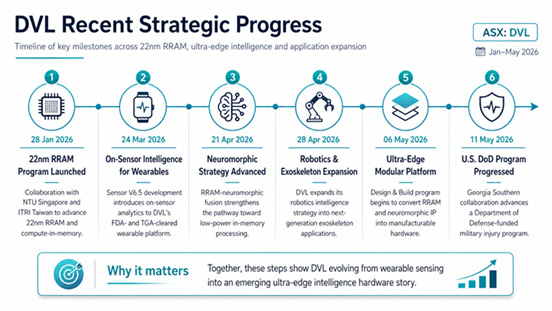
- In March 2026, DorsaVi said it had commenced on-sensor intelligence for wearables through its V6.5 firmware program, which is part of the broader move toward local processing and reduced latency.
- In the March 2026 quarterly report, the company confirmed the start of its 22nm RRAM fabrication and co-design program with NTU and ITRI and described the 22nm program as a strategic inflection point for commercial-scale intelligent hardware.
- On 18 May 2026, DorsaVi announced that three RRAM material stacks had passed BEOL compatibility testing, which removed a key materials barrier and marked an important step toward commercial foundry integration.
- The same announcement stated that the 180nm RRAM test chip was in final pre-tape-out stage, with submission to a Tier-1 foundry targeted for Q3 2026.
- On 1 June 2026, the company reported that its RRAM showed stable and reversible performance at 150°C, which is particularly important for sealed and uncooled environments such as robotics and exoskeleton systems.
- On 4 June 2026, DorsaVi said evaluation work indicated up to at least 2x battery improvement in exoskeleton and robotics applications, together with projected reductions in sensor count, wireless data transfer and processing load.
Taken together, these updates suggest the program is progressing across materials, architecture, temperature stability, system efficiency and foundry readiness at the same time.
What This Could Mean in Practice
If the RRAM roadmap continues to advance, it could significantly improve how DorsaVi’s future hardware performs in real-world edge environments.
The company’s recent announcements suggest the intended benefits include lower battery consumption, faster local decision-making, reduced dependence on cloud connectivity, fewer sensors, less wireless bandwidth and better operation in heat-constrained environments. These are not minor efficiency gains. In target markets such as exoskeletons, robotics and advanced wearables, those factors can directly affect usability, operating time and product design.
This is why the RRAM story matters more than the legacy product discussion. It has the potential to shift DorsaVi from a company known mainly for movement analysis hardware into one with a more differentiated semiconductor and ultra-edge technology position.
RRAM and Ultra-Edge Intelligence
This is now the most important part of the DorsaVi investment story.
The company is developing an RRAM, neuromorphic and ultra-edge computing platform aimed at enabling intelligence directly on-device, rather than relying on conventional architectures that consume more power and depend more heavily on external processing. The focus is on use cases where power efficiency, thermal stability, low latency and compact system design matter most.
DorsaVi’s recent announcements show that this work is becoming more tangible. The company has now moved through several technical steps that are directly relevant to commercialisation.
The first is materials readiness. DorsaVi announced in May 2026 that three RRAM material stacks had passed BEOL compatibility testing, which is a key requirement for foundry-based manufacturing. This is important because it reduces one of the major practical risks in taking an emerging memory technology from research into a scalable production pathway.
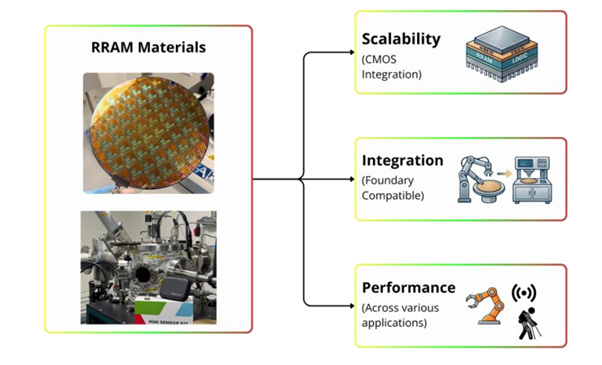
All-Day AR Wearability with Always-On Perception, Event-Driven Intelligence, and Ultra-Low-Power Computing.
The second is chip pathway development. The company said its 180nm RRAM test chip had reached final pre-tape-out stage, with submission to a Tier-1 foundry targeted for Q3 2026. At the same time, DorsaVi continues to position 22nm as the longer-term commercial node, with the 22nm program combining device design, system architecture and co-development work with NTU and ITRI.
The third is operating performance. In early June 2026, DorsaVi reported that its RRAM demonstrated stable and reversible behaviour at 150°C, which is highly relevant for sealed systems such as robotics, motor-adjacent electronics and exoskeleton hardware where cooling is limited and thermal stress can become a major problem.
The fourth is system-level efficiency. The company’s 4 June 2026 update indicated that its RRAM and neuromorphic approach could deliver up to at least 2x battery improvement in exoskeleton and robotics settings, while also reducing sensor count, wireless data transfer and processing load. That is an important practical signal because it connects the semiconductor story to measurable end-use benefits rather than leaving it as a purely theoretical chip discussion.
The fifth is architecture integration. DorsaVi has linked its RRAM work to Ultra-Edge AI and Sensor V6.5, which means the memory roadmap is being developed alongside in-sensor analytics and local decision-making capabilities. This gives the strategy more coherence because the company is not developing memory in isolation. It is building toward a broader system where sensing, compute and memory operate together at the edge.
In practical terms, the RRAM roadmap is designed to support applications such as exoskeletons, robotics, autonomous systems, advanced wearables and industrial sensing. These are all markets where local intelligence and better energy efficiency can matter more than headline compute power.
This is why the recent announcements matter. They show that DorsaVi is progressing across multiple layers of the stack at once: materials, foundry readiness, chip design, thermal resilience, system efficiency and application fit. That gives the RRAM strategy more credibility than a typical early-stage semiconductor concept and makes it the clearest source of upside in the current DorsaVi story.
Clinical, Sports and Workplace Positioning
What makes DorsaVi different is that it already has real-world product pathways across multiple end markets.
In clinics and sports, the company offers movement analysis tools that support rehabilitation, return-to-sport decisions and performance assessment. In workplaces, it provides tools to help identify and reduce injury risk. In research, it offers precision data capture for biomechanics and human movement studies.
This installed product logic matters because the newer edge AI and RRAM strategy is not being developed in a vacuum. DorsaVi already understands real-world motion sensing use cases, which gives context to where future ultra-edge intelligence products may be deployed.
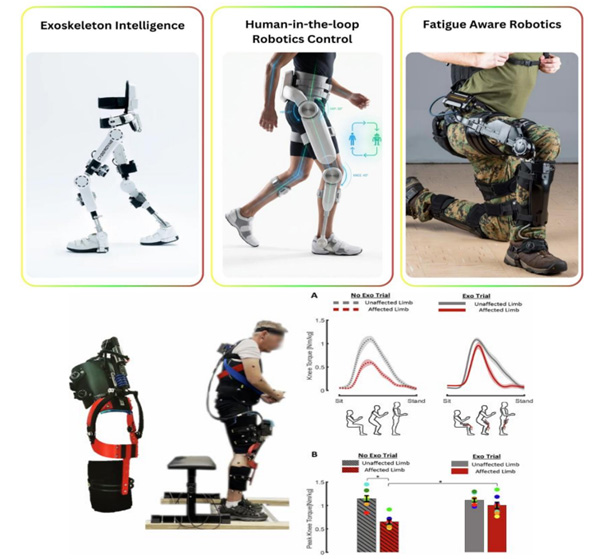
All-Day AR Wearability with Always-On Perception, Event-Driven Intelligence, and Ultra-Low-Power Computing.
Peer Analysis
The earlier Phoenix comparison set around small-cap AI names is no longer the most useful way to look at DorsaVi.
Today, the better comparison is with companies and themes linked to next-generation memory, low-power edge AI and specialised semiconductor hardware.
The clearest listed benchmark is Weebit Nano. Weebit is more advanced commercially, with licensing progress and foundry relationships already in place, but it remains a useful peer because it shows how the market can value credible ReRAM pathways well before full-scale royalty maturity. In that sense, Weebit is important less because it is identical to DorsaVi, and more because it demonstrates that investors are willing to assign serious value to memory technologies that show technical progress, manufacturability and commercial relevance.
A second useful reference point is Everspin, which operates in the broader next-generation memory space through MRAM. Everspin is not a direct RRAM peer, but it helps show that specialised memory technologies can support real revenue and customer adoption when they solve practical performance problems that conventional memory struggles to address.
The broader market backdrop also matters. AI has made memory one of the most important parts of the hardware stack, with increasing investor attention on HBM, DRAM, NAND, enterprise SSDs and other memory-adjacent technologies. That backdrop is relevant to DorsaVi because RRAM sits inside the next-generation memory category and is increasingly tied to themes such as compute-in-memory, ultra-edge inference and on-device intelligence.
This is where DorsaVi’s positioning becomes more interesting. The company is not simply pursuing another low-power chip concept. It is building around a specific architecture where sensing, memory and inference are intended to work closer together on the device. That matters for applications where constant cloud processing is inefficient, battery life is constrained, and fast local response is important.
Compared with the more advanced names in the memory and semiconductor space, DorsaVi is still earlier stage. That means the risk profile is higher. But it also means the valuation starting point is much lower, which is why each technical milestone matters. Passing BEOL compatibility testing, progressing toward foundry tape-out, demonstrating high-temperature stability and showing potential battery gains in end-use applications all help make the pathway more tangible.
In short, the peer framework has changed. DorsaVi should now be viewed less against generic AI software microcaps and more against the emerging memory and ultra-edge hardware thematic, where the relevant questions are manufacturability, scalability, node progression, power efficiency and application fit.
Target End Markets
DorsaVi has highlighted several large end markets that could benefit from lower-power memory, compute-in-memory and ultra-edge intelligence. These are important because they show the company is not building the RRAM program around a narrow single-use case.
| Target Market | Indicative Market Size |
| Robotics | Up to US$372.59 billion by 2034 |
| Industrial automation and control | US$378.57 billion by 2030 |
| Wearables | US$186.14 billion by 2030 |
| Autonomous vehicle systems | US$214 billion by 2030 |
| Industrial IoT and edge AI hardware | US$68.7 billion by 2031 |
| Ultra-edge AI | US$66.47 billion by 2030 |
| Exoskeletons | Projected to exceed US$2 billion by 2033 |
These markets vary in maturity and timing, but the common thread is the same. They all favour faster local processing, lower power draw, reduced wireless dependence and better thermal efficiency. That is exactly the operating profile DorsaVi is trying to address through its RRAM and ultra-edge roadmap.
Leadership
- Mathew Regan, Group CEO
- Andrew Ronchi, CEO, Sensors Division
- Gernot Abl, Chairman
- Leigh Travers, Non-Executive Director
- Vineet Agarwal, Non-Executive Director
The current leadership structure reflects DorsaVi’s broader direction, with commercial leadership across the core product business and strategic oversight as the company expands into semiconductors, robotics and ultra-edge computing.
Upcoming Catalysts
- Further updates from the 22nm RRAM program
- Progress on commercial foundry integration and chip design
- Ongoing rollout of Sensor V6.5 and on-sensor intelligence capability
- Additional validation work in robotics and exoskeleton applications
- Continued development of Video AI, ViMove+ and ViSafe+ across clinical and workplace markets
Further evidence of commercial traction across DorsaVi’s product suite
Investment View
DorsaVi is becoming a broader technology story than the market historically gave it credit for.
The original Phoenix page focused mainly on wearable sensors, SaaS transition, workplace customers and the valuation gap relative to other small ASX AI names. That logic still has some relevance, especially around its established product base. But the company has now moved well beyond that phase.
Today, the key investment case sits in the combination of:
- an existing base of commercial movement and sensor products,
- a more advanced RRAM and ultra-edge technology roadmap,
- growing relevance to the broader AI memory and hardware cycle, and
- exposure to large end markets such as robotics, exoskeletons, wearables, industrial automation and autonomous systems.
That changes how the company should be viewed. DorsaVi is no longer only a legacy wearables name with a software overlay. It is increasingly becoming an early-stage ultra-edge intelligence and memory hardware story, with recent announcements beginning to support the manufacturing and commercial logic behind that shift.
For Phoenix readers, the attraction is that DorsaVi now offers both a real operating technology base and a much more leveraged deep-tech pathway if the RRAM roadmap continues to progress.
Ongoing Research Articles

DorsaVi Ltd Investment Report
About: DorsaVi Limited Overview DorsaVi Ltd (ASX: DVL) is an Australian robotics-focused deep-technology company, evolving from its medtech sensor origins into a global innovator in robotics, semiconductors, [...]
DorsaVi Limited (ASX:DVL) Investment Report
About: DorsaVi Limited Overview: DorsaVi Ltd (ASX: DVL) is an Australian-based med-tech company that has historically focused on biomechanical sensor solutions for clinical, sports, and occupational safety applications. The [...]
DorsaVi Limited (ASX:DVL) Investment Report
AI & Blockchain-Based Motion Analytics by DorsaVi Overview: DorsaVi is an innovative technology company specialising in wearable sensor solutions and Video AI data analytics to understand and optimise human [...]
DorsaVi Incorporates Blockchain in its Technology
Company: Dorsavi LtdTicker: DVLSector: Artificial Intelligence / TechDorsaVi Incorporates Blockchain in its Technology DorsaVi (DVL) have just announced it has commenced integrating blockchain technology into its core data platform, which [...]