

Sector: Critical Minerals Exploration, Rutile, Graphite and Rare Earths
Snapshot: (as of 4th June 26)
Share Price: AUD 0.1300
Market Cap: AUD 40.74 M
Enterprise Value: AUD 34.33 M
Cash: Last reported cash at 31 March 2026 was A$6.409 million
What Does Fortuna Do?
Fortuna Metals Limited (ASX: FUN) is an Australian critical minerals explorer focused on building a large-scale rutile project in Malawi, with growing graphite and rare earth potential emerging across the same mineral system.
The company’s Mkanda and Kampini licences cover 658 sq km in the Lilongwe Plain, directly south of Sovereign Metals’ Kasiya deposit. Fortuna is targeting shallow, free-dig mineralisation from surface in a region that is rapidly gaining attention as a globally relevant rutile province.
What makes the story increasingly compelling is that the project is no longer only an early-stage adjacent-ground concept. Fortuna has now outlined a large exploration target at Mkanda, expanded the known rutile footprint materially, and started building the basis for a maiden inferred resource through additional hand auger and aircore drilling.
In parallel, graphite and heavy rare earth results are adding another layer to the project, highlighting the possibility that Mkanda could develop into a broader multi-commodity critical minerals opportunity rather than a simple single-mineral exploration story.
Recent Developments
- 27 April 2026: Fortuna reported further drilling results from the Mkanda Rutile-Graphite Project, with rutile mineralisation continuing over a broad area and shallow 0 to 2 metre samples returning peak results up to 2.52% rutile. The update also reinforced the scale of the system, with the company noting that the coherent rutile footprint at Mkanda had expanded to around 53 sq km, including a higher-grade core of about 28 sq km.
- 7 April 2026: Fortuna announced a globally significant exploration target for Mkanda of 180 to 240Mt at 0.86% to 1.0% total rutile, based on drilling completed across the project. This was a major step forward for the Malawi assets and gave the company a clearer base from which to move toward maiden resource work.
- January 2026 quarter: Fortuna confirmed it was advancing Mkanda through resource drilling and metallurgical testwork, with a focus on confirming rutile quality as a high-purity titanium feedstock and progressing the project toward a maiden inferred resource.
- 29 January 2026: Fortuna’s quarterly activities report highlighted the early scale of the Malawi opportunity, including high-grade rutile drill results at Mkanda such as 10m at 1.66% rutile and 10m at 1.32% rutile, both ending in mineralisation. The update showed that rutile mineralisation was already being confirmed over a large area at shallow depth.
- 17 November 2025: Fortuna reported exceptional phase 1 soil results from the Mkanda project, with assays up to 2.32% rutile, helping establish the broader prospectivity of the Malawi ground ahead of the larger drill-driven updates that followed.
Fortuna’s Projects in Malawi, in More Detail
Fortuna’s Malawi portfolio centres on two granted licences, Mkanda and Kampini, which together cover 658 sq km in the Lilongwe Plain. The ground sits immediately south of Sovereign Metals’ Kasiya project, which is important because it places Fortuna inside the same broader rutile-graphite province rather than on an isolated conceptual trend.
The reason these projects matter is not simply their location next to Kasiya. It is that Fortuna has already started to generate its own project-level technical evidence across a very large land position. The company has moved beyond acquisition-stage positioning and is now using drilling, sampling, metallurgy and mineralogical work to define which parts of the ground have the best chance of supporting a future resource.
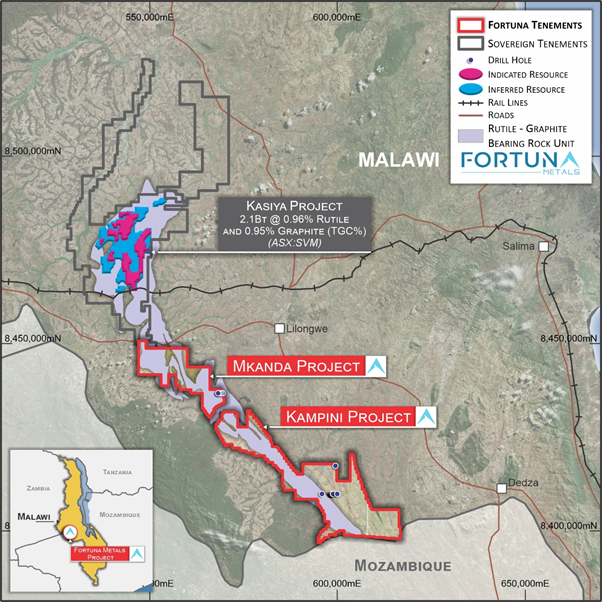
Locations of the Projects in Malawi, Africa.
Mkanda, the clear lead project
Mkanda is the main value driver in the portfolio and the project where Fortuna has done the bulk of its drilling and technical work to date. The company has completed 675 drill holes across about 180 sq km of Mkanda on broad reconnaissance spacing, initially to identify the distribution of rutile and graphite mineralisation and then to define the highest-priority zones for tighter-spaced follow-up drilling.
This work has already changed the quality of the story. Mkanda is no longer just prospective ground near a major discovery. It now has a defined Exploration Target of 180 to 240Mt at 0.86% to 1.0% total rutile, a coherent rutile anomaly footprint of roughly 53 sq km, and a higher-grade core zone of around 28 sq km that is becoming the main focus for resource drilling.
That is important because it gives Mkanda three things investors generally want to see at this stage. First, scale. Second, a growing technical basis for continuity. Third, identifiable higher-grade zones that can be prioritised for the next phase of drilling and development studies.
Fortuna’s work at Mkanda has also highlighted the likely importance of depth. The initial hand auger drilling was intentionally shallow and averaged around 8 metres, with many holes stopping when sample quality declined near the water table. The company has made it clear that the current exploration target is based on only the shallower part of the weathered profile, with an average depth of about 4.1 metres in the exploration target area. This means deeper aircore drilling could materially improve the understanding of total thickness and potentially lift the eventual resource base if mineralisation continues deeper toward the free-dig boundary.
In simple terms, Mkanda is attractive because it already looks large at shallow depth, and it may yet prove larger when the deeper saprolite profile is tested properly.
Current workstreams at Mkanda
The Mkanda project is now moving through several parallel workstreams, which is important because it shows Fortuna is not relying on a single data stream.
- Resource drilling: Fortuna has flagged 200m x 200m drilling across the highest-grade areas to support maiden resource definition.
- Aircore drilling: More than 5,000 metres of aircore drilling has been planned to test mineralisation deeper into the saprolite and toward the free-dig limit.
- Metallurgy: A 5 tonne bulk sample is being processed through a conventional mineral sands flowsheet by Mineral Technologies, targeting a rutile concentrate of greater than 95% titanium.
- Graphite work: Graphite intervals have been reported in the same broader mineralised system, with selected holes showing grades increasing with depth.
- Rare earth work: Mineralogical work has identified monazite and xenotime, and the company has flagged additional work on graphite and heavy rare earth exploration target potential later in 2026.
This combination matters because it helps move Mkanda from exploration concept toward development logic. Drilling shows where the mineralisation is. Metallurgy helps test whether that mineralisation can translate into a marketable product. Mineralogy and by-product work help determine whether the value case is broader than rutile alone.
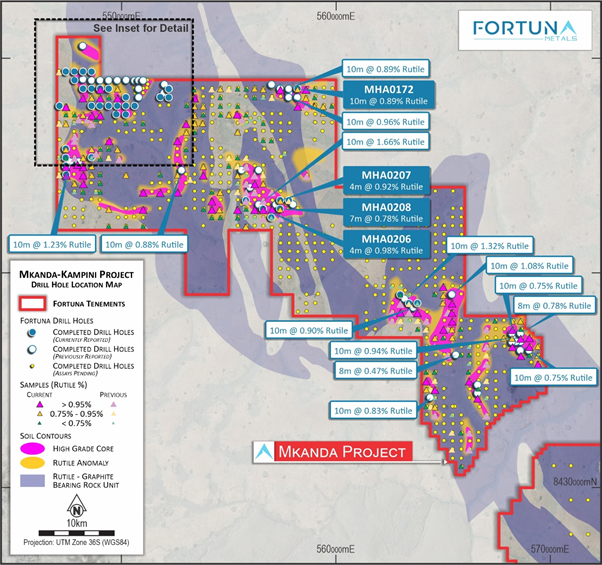
Significant rutile intercepts showing multiple large cohrent rutile anomalies (light green) with central high grade cores (dark green)
Kampini, the second project with follow-up potential
Kampini is less advanced than Mkanda, but it remains strategically relevant within the Malawi portfolio. Fortuna completed 28 drill holes at Kampini during the initial phase of work, and the project gives the company a second licence position within the same broader province.
At this stage, Kampini should be viewed as an important follow-up and optionality asset rather than the immediate lead project. That does not reduce its importance. In district-scale exploration stories, secondary licences often become more valuable as geological understanding improves across the main project. If Mkanda continues to demonstrate the broader fertility of the system, Kampini may benefit from that read-through over time.
In practical terms, Kampini gives Fortuna room to grow beyond a single-target narrative. It gives the company another area where the same exploration model can be tested and refined, and it increases the strategic value of Fortuna’s overall ground holding in Malawi.
Why the Malawi portfolio stands out
Taken together, Mkanda and Kampini give Fortuna exposure to one of the most important new rutile districts emerging in the listed market. The portfolio has several strengths:
- it sits immediately south of a globally significant rutile-graphite benchmark,
- it covers a large district-scale land position,
- it hosts shallow mineralisation from surface,
- it is already showing multiple coherent rutile zones rather than a single isolated target,
- it has growing graphite and heavy rare earth optionality, and
- it is now moving into the stage where maiden resource definition becomes realistic rather than theoretical.
That combination is what makes the projects important. Fortuna is still earlier stage than the district leader, but it has already done enough work to establish that its Malawi ground deserves to be assessed on its own merits.
Strategic Location and Infrastructure Advantage
Fortuna’s Malawi position is not only geologically attractive, it is also supported by practical infrastructure advantages that matter in exploration and development.
The project is located close to Lilongwe and benefits from access to sealed roads, power and regional logistics routes. The company has highlighted proximity to the Nacala export corridor, which is an important strategic pathway for bulk commodities from landlocked southern Africa to deep-water port infrastructure in Mozambique.
This matters because titanium feedstock projects are not only judged on grade and scale. Logistics, transport costs, export pathways and ease of access can have a major influence on project quality over time. Fortuna’s land package stands out because it combines district-scale exploration upside with a setting that already supports the concept of future development.
Style of Mineralisation
The Mkanda and Kampini projects are targeting shallow, blanket-style rutile and graphite mineralisation developed through prolonged weathering of favourable bedrock. In this style of system, rutile and graphite can become concentrated in soft, near-surface saprolite and residual material.
This is important because such deposits may be simpler and cheaper to explore than harder rock systems. They can also offer potential mining advantages if mineralisation proves continuous, sufficiently thick and laterally extensive.
Fortuna’s drilling to date suggests broad zones of rutile mineralisation from surface, with selected areas remaining open at depth. The next stage of drilling is designed to improve understanding of continuity, thickness and the depth extent of the free-dig profile.
Why Rutile Matters
Natural rutile is one of the highest-value titanium feedstocks because of its high titanium dioxide content and its importance in titanium metal, welding, pigments and advanced industrial applications.
Fortuna’s investment case is increasingly tied to the view that natural rutile supply is tightening globally while strategic demand remains strong across aerospace, defence, industrial coatings and advanced manufacturing.
That matters for Malawi because this region is emerging as one of the few places globally where new, potentially large-scale natural rutile projects are being defined at a time when premium titanium feedstock is becoming harder to secure.
Why This Story Has Strengthened
The Fortuna story has advanced materially from where it stood when the original Phoenix page was first published.
At that stage, the investment case was largely based on location, geological analogy and early exploration logic. It has now moved into a more advanced phase supported by:
- a defined exploration target at Mkanda,
- a materially larger mapped rutile footprint,
- evidence of higher-grade core zones,
- ongoing drilling aimed at maiden resource definition,
- graphite assays that support potential by-product value, and
- early heavy rare earth indicators that add strategic optionality.
In other words, Fortuna is no longer just a neighbour story. It is increasingly building its own project identity within the same mineral province.
Peer Comparison
Fortuna’s closest peer comparison is Sovereign Metals’ Kasiya project in Malawi, which sits directly to the north and remains the key benchmark for the district.
Kasiya is a much more advanced project, while Fortuna is still earlier stage and working toward a maiden inferred resource. Even so, the comparison is important because it highlights that Fortuna’s ground sits within the same broader rutile and graphite province in the Lilongwe Plain.
A broader comparison can also be made with listed titanium and rutile explorers such as Liberty Metals in Brazil and PTR Minerals in Australia. These companies are targeting titanium-rich systems, but the geology and project style are different.
What makes Fortuna stand out is its combination of shallow rutile mineralisation, district-scale landholding, graphite and rare earth upside, and strong read-through from its location immediately south of Kasiya. While it remains earlier stage than the leading names in the sector, the company is continuing to build its own project profile through drilling, metallurgy and resource-focused work in Malawi.
Leadership
- Tom Langley, CEO: Geologist with experience across exploration, project generation and resource development.
- Peter Pawlowitsch, Chairman: Corporate finance and public markets experience.
- David Frances, Non-Executive Director: Extensive mining and African operational experience.
- Brian Thomas, Non-Executive Director: Strong listed company and transaction background.
Upcoming Catalysts
- Remaining full-hole rutile assays from prior drilling
- Ongoing hand auger drilling across priority zones
- More than 5,000 metres of aircore drilling to test depth potential
- Graphite assays and further metallurgical work
- Ongoing rare earth analysis and mineral characterisation
- Maiden inferred resource estimate targeted for H2 2026
Investment View
Fortuna offers exposure to a fast-emerging rutile district in Malawi, supported by growing evidence that Mkanda could become a meaningful rutile project in its own right.
The company now has a stronger foundation than it did at listing and rebrand stage. It has defined a large conceptual exploration target, demonstrated shallow rutile mineralisation across a broad footprint, and is moving into the next phase of drilling designed to support maiden resource estimation.
What also adds to the appeal is that this is not purely a rutile story. Graphite and heavy rare earth work has started to show that Mkanda may carry broader strategic mineral value, which could become increasingly important as drilling and metallurgical studies continue.
For Phoenix readers, the attraction is the combination of district-scale ground, growing technical evidence, shallow mineralisation, improving development logic and multiple upcoming catalysts across 2026.
Ongoing Research Articles
Fortuna Metals Limited Investment Report
Fortuna Metals: A Tier-One Rutile-Graphite Opportunity in Malawi Read full report here
Fortuna Metals Limited Investment Report
Fortuna Metals: A Tier-One Rutile-Graphite Opportunity in Malawi Fortuna Metals Limited (ASX: FUN) is an Australian critical minerals company focused on the discovery and development of rutile and [...]