

Sector: Uranium and Lithium Exploration
Snapshot: (as of 4th June 26)
Share Price: AUD 0.1350
Market Cap: AUD 15.69 M
Enterprise Value: AUD 7.41 M
Cash: Last reported cash at 31 March 2026 was A$8.281 million
Macro Environment, Company Background & Recent Performance
Infini Resources is an uranium-focused exploration company with a growing portfolio across Canada and Australia, while still retaining lithium optionality in selected projects.
The company’s strongest market relevance currently comes from its Canadian uranium assets, where exploration activity is centred on two main growth fronts.
The first is Portland Creek in Newfoundland, where the company has completed two phases of drilling and identified a large structurally controlled uranium system supported by very high-grade soil results, visible uranium in drilling, polymetallic pathfinders and project-wide airborne geophysics.
The second is the Reynolds Lake and Reitenbach Lake projects on the eastern margin of the Athabasca Basin in Saskatchewan, where maiden drilling commenced in April 2026. These projects add exposure to an underexplored but geologically compelling uranium system within one of the best-known uranium belts in the world.
Infini still retains lithium optionality, but the core investment case is currently uranium.
Recent Developments
- 26 May 2026: Infini completed a project-wide airborne geophysics program at Portland Creek, including TDEM, magnetics and radiometrics. This is important because it is intended to refine structural interpretation, identify priority anomalies and support the next phase of drill targeting across the broader uranium system.
- 29 April 2026: Infini commenced maiden diamond drilling at Reynolds Lake and Reitenbach Lake in Saskatchewan. The minimum 2,500 metre, 12-hole program is testing targets generated from the convergence of EM conductors, structural corridors and uranium geochemical anomalism, including areas around the Titus Prospect, where rock chips returned up to 1.90% U₃O₈.
- 24 April 2026: The company received drill permits for Reynolds and Reitenbach Lake, clearing the path for maiden drilling on the eastern margin of the Athabasca Basin.
- 31 March 2026 quarter: Infini reported that the first batch of Phase 2 Portland Creek assays confirmed a structurally controlled uranium system, with uranium mineralisation associated with fractures, breccias and altered granite zones. The same quarter also saw drill targets finalised at Reynolds and Reitenbach, and the Reitenbach footprint expanded further.
- 9 February 2026: Infini reported that assays from Portland Creek supported a coherent, multi-kilometre mineralised system, with elevated uranium accompanied by molybdenum, zinc and copper pathfinders, pointing to a broader hydrothermal mineralising framework.
Company Assets, Progress & Strategy
1. Portland Creek Uranium Project, Newfoundland, Canada
Portland Creek is one of the most important assets in the Infini portfolio and remains the company’s lead uranium discovery story.
The project now spans 328 km² and sits within a largely underexplored uranium province in Newfoundland and Labrador. What has made Portland Creek stand out is the combination of surface geochemistry, structural interpretation and drilling data all pointing toward a large uranium-bearing system rather than an isolated anomaly.
The company has now identified a ~6 km zone of anomalous uranium and radon gas responses across lake sediments, soils and airborne radiometrics. This anomalism follows a major structural feature interpreted as a deep-seated fault, which is important because the company’s current model is built around structurally focused fluid pathways controlling uranium mineralisation.
Portland Creek has also generated some of the strongest early-stage uranium surface results seen in the market. Previous field programs defined a ~800 m x 100 m high-grade uranium soil anomaly with peak assays up to 74,997 ppm U₃O₈, or roughly 7.5% U₃O₈, with additional high-grade soil clusters identified elsewhere on the project.
More recently, Phase 2 drilling and assay work have moved the story beyond surface geochemistry. The first batch of drill assays confirmed uranium mineralisation across multiple holes and targets, with mineralisation hosted in fractures, joints, breccias and altered granite zones. Recent announcements reported drill assays up to 347 ppm U₃O₈, together with elevated molybdenum, zinc and copper, which supports the idea that Portland Creek may host a broader fertile hydrothermal system rather than a simple narrow uranium occurrence.
The latest project-wide airborne geophysics program is now expected to sharpen structural interpretation further and help support a Phase 3 drill program in Q2/Q3 2026.
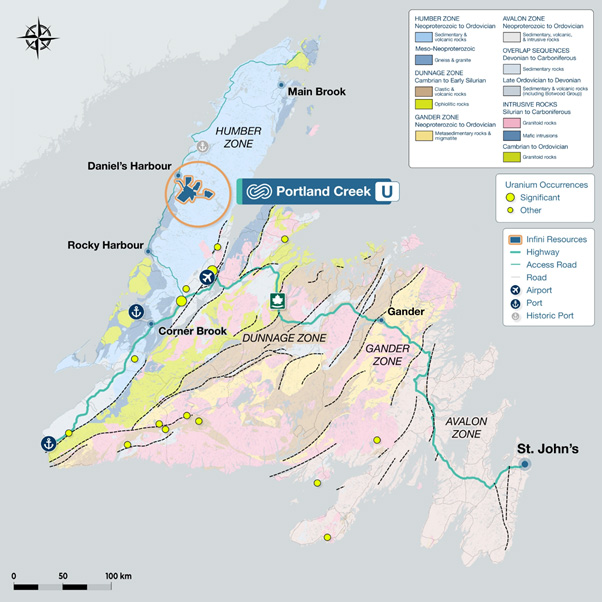
The Portland Creek Uranium Project covers a significant 328 km²
2. Reynolds Lake and Reitenbach Lake Uranium Projects, Saskatchewan, Canada
Reynolds Lake and Reitenbach Lake have become the second major pillar of the Infini uranium story.
Together, the projects comprise 19 mineral claims covering 677 km² on the eastern margin of the Athabasca Basin. Reynolds Lake accounts for 386 km² and Reitenbach Lake 291 km². The geological setting is important because the projects sit along the Needle Falls Shear Zone, a crustal-scale structural corridor considered prospective for basement-hosted uranium systems.
Infini has described the district as analogous in part to uranium systems such as Eagle Point and Rabbit Lake, with graphitic lithologies, EM conductors, structural complexity and uranium anomalism all present across the project area.
Recent field work confirmed uranium mineralisation at surface, including the high-grade Titus Prospect, where rock chips returned up to 1.90% U₃O₈. The same broader field program also identified additional uranium mineralisation up to 0.19% U₃O₈ at Javelin and 0.03% U₃O₈ at Voyager. Broader exploration confirmed widespread uranium anomalism across an approximately 15 km by 3 km corridor, which is why the company believes the system may be district-scale rather than isolated.
The company has now progressed from field mapping and geophysics into maiden drilling, which is a major step forward. The current program is testing the first drill targets ever generated at these projects and is designed to evaluate zones where EM conductors, magnetic features, structural corridors and uranium geochemistry all coincide.
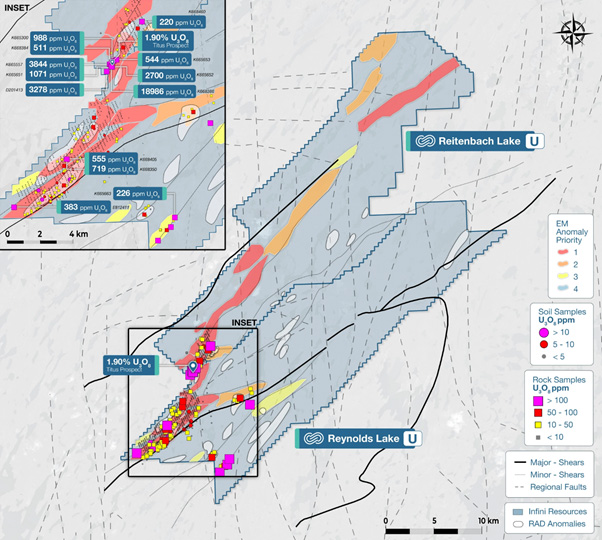
The Reynolds Lake and Reitenbach Lake Projects are located in northern Saskatchewan, Canada, within the broader Athabasca Basin region
3. Des Herbiers Uranium Deposit, Québec, Canada
Des Herbiers remains an important background asset because it provides Infini with a defined uranium resource.
The project hosts a JORC 2012 inferred mineral resource of 162Mt at 123 ppm U₃O₈ for 43.95Mlb U₃O₈ across 36.25 km². That makes it one of the more material legacy assets in the portfolio.
However, it is not currently the main market driver because no significant work was undertaken there during the March 2026 quarter and Québec’s uranium moratorium continues to limit the immediate development pathway.
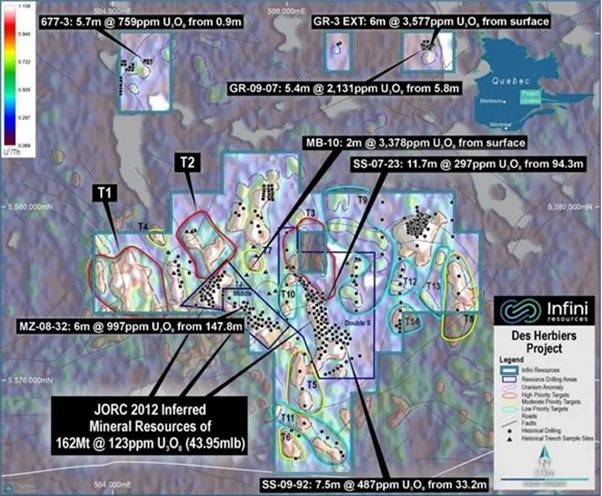
The Des Herbiers Uranium Project
4. Yeelirrie North and Bellah Bore East, Western Australia
Infini also retains uranium optionality in Western Australia.
Yeelirrie North currently covers about 329 km², with exploration licence applications that could expand the project to around 746 km² if granted. The project sits in the same broad domain as Cameco’s Yeelirrie uranium deposit.
Bellah Bore East adds a smaller historical uranium deposit position within the same broader project area.
These assets are not the current focus, but they still add portfolio depth and long-term optionality.
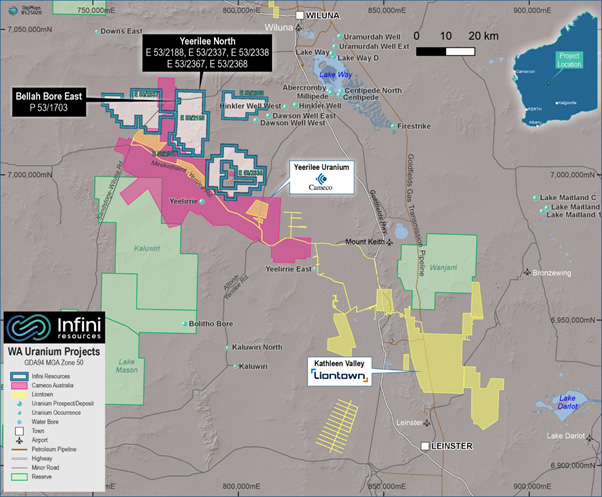
The Yeelirrie North Project
Peer Analysis
Infini is best compared with a mix of:
- active uranium explorers with current drilling and discovery leverage, and
- more advanced uranium companies with defined resources that help frame how the market values uranium exposure as projects de-risk.
| Metric | I88 | PEN | EL8 | CXU |
| Market cap | ~A$15.69m | ~A$212.26m | ~A$114.16m | ~A$89.62m |
| Enterprise value (approx.) | ~A$7.41m | ~A$189.57m | ~A$80.16m | ~A$85.32m |
| Cash (latest quarter-end) | ~A$8.281m | ~US$16.3m (about A$22.7m) | ~A$34.0m | ~A$4.3m |
| Top 20 ownership (approx.) | ~50.8% | ~62.5% | ~58.9% | ~65.8% |
| Project location | Newfoundland and Saskatchewan, Canada | Wyoming, USA | Namibia and Australia | Western Australia |
| Tenement size (km2) | 328 km2 at Portland Creek | ~223 km2 at Lance | ~545 km2 at Koppies Project area | ~1,250 km2 at Yanrey |
| Flagship project | Portland Creek Uranium Project | Lance Uranium Project | Koppies Uranium Project | Yanrey Uranium Project |
| Ownership | 100% | 100% | 100% at Koppies, broader portfolio includes 75%-owned Marenica | 100% |
| Exploration stage | Drilled and active target expansion, with maiden drilling also underway at Reynolds and Reitenbach | Production ramp-up and development, with satellite growth options | Resource and development stage, plus ongoing exploration and beneficiation work | Resource and exploration target stage, with 2026 drilling focused on growth |
| Headline grades | Soils up to 7.5% U3O8, Titus rock chips up to 1.90% U3O8, drill assays up to 347 ppm U3O8 | Lance resource at 500 ppm U3O8 average, with Dagger at 1,037 ppm U3O8 | Koppies Project total resource at 192 ppm U3O8, Marenica at 183 ppm U3O8, Angela at 1,310 ppm U3O8 | Bennet Well at 358 ppm eU3O8, Manyingee North at 297 ppm eU3O8 |
| Exploration results | High-grade surface uranium up to 74,997 ppm U3O8 at Portland Creek, drilling confirmed a structurally controlled uranium system, and Titus rock chips up to 1.90% U3O8 in Saskatchewan | Lance hosts 58 Mlb U3O8 at average grade 500 ppm, is ramping up production, and Dagger adds 6.9 Mlb U3O8 at 1,037 ppm as a higher-grade satellite growth option | Koppies Project total resource now 66.1 Mlb U3O8 at 192 ppm, with Marenica updated to 40.2 Mlb U3O8 at 183 ppm and additional high-grade Australian assets | Yanrey hosts more than 55 Mlb U3O8 across Bennet Well, Manyingee South and Manyingee North, with drilling confirming further ISR-suitable growth potential |
| Other projects | Reynolds & Reitenbach, Des Herbiers, Yeelirrie North, Bellah Bore East, Paterson Lake, Valor | Dagger Project and broader Lance regional growth pipeline including Kendrick and Barber | Hirabeb, Namib IV, Marenica, Capri, Angela, Thatcher Soak, Minerva and JV interests | Primarily Yanrey-focused, plus surrounding regional tenements and legacy WA exploration optionality |
| Comments | Stronger cash backing than many microcap uranium peers, with two active Canadian uranium fronts and legacy resource support from Des Herbiers | Much larger and more advanced uranium peer, already in production ramp-up, useful as a higher-value benchmark rather than a direct discovery-stage comparison | More advanced uranium benchmark with a larger resource base, stronger balance sheet and development pathway through U-pgrade | Resource-backed uranium benchmark with ISR-style development logic, though subject to Western Australia uranium policy risk |
Infini sits well below PEN, EL8 and CXU on market value, which highlights the gap between a discovery-stage uranium company and more advanced resource or production-backed peers. Even so, Infini stands out for its strong cash backing, active exploration across two Canadian uranium fronts, and growing pipeline of drill and target-generation catalysts. The grade row is also useful because it shows that I88 is competing for market attention against peers with established resource grades and larger resource bases, while still offering much earlier-stage exploration leverage.
Leadership
- Rohan Bone, Chief Executive Officer
- Dr David Pevcic, Executive Director
- Andy Wilde, Non-Executive Director
- Raymond Chen, Chief Financial Officer
The leadership update is also relevant because the company appointed Rohan Bone as CEO in May 2025 to lead the next phase of growth across the uranium and lithium portfolio, and the more recent project work suggests the company has become increasingly execution-focused since then.
Upcoming Catalysts
- Interpretation of the Portland Creek airborne geophysics program
- Remaining Phase 2 Portland Creek assay results
- Design and commencement of Phase 3 drilling at Portland Creek
- Ongoing maiden drill results from Reynolds and Reitenbach Lake
- Further target generation across the expanded Athabasca-margin footprint
- Possible follow-up work across Yeelirrie North, Bellah Bore East and other non-core uranium assets
Investment View
Infini Resources offers a uranium-focused exploration story with meaningful activity already under way at both Portland Creek and the Reynolds/Reitenbach projects.
Portland Creek has delivered strong surface geochemistry, encouraging drill indications and a structurally controlled uranium model that continues to strengthen with each round of work. Reynolds and Reitenbach have now moved into maiden drilling, giving the company a second active uranium growth front in a geologically attractive district on the eastern margin of the Athabasca Basin.
The company’s cash position is also stronger than many microcap peers, which matters because it gives Infini more flexibility to continue drilling and target generation without the same immediate capital pressure faced by some junior explorers.
For Phoenix readers, the attraction is the combination of:
- a modest valuation base,
- strong uranium leverage,
- active news flow across two Canadian uranium fronts,
- legacy resource support from Des Herbiers, and
a clear near-term path to value creation through drilling and discovery work.
Ongoing Research Articles
Infini Resources Investment Report
Infini Resources: Shaping Tomorrow's Energy with Uranium Overview: Infini Resources is an ASX-listed exploration company focused on the high-growth lithium and uranium markets. With a portfolio of [...]
Stunning High Grade Uranium Soil Results at Portland Creek
Company – Infini Resources Ticker – ASX:I88 Sector – Uranium / Lithium Initial Investment Thesis – https://phoenixglobalinvestments.com.au/infini-resources-asxi88/ “Some Of The Highest Uranium Soil Grades Returned Globally” Infini Resources (I88) [...]